Slick.js: Responsive & Flexible jQuery Carousel Slider Plugin
| File Size: | 52 KB |
|---|---|
| Views Total: | 559758 |
| Last Update: | |
| Publish Date: | |
| Official Website: | Go to website |
| License: | MIT |
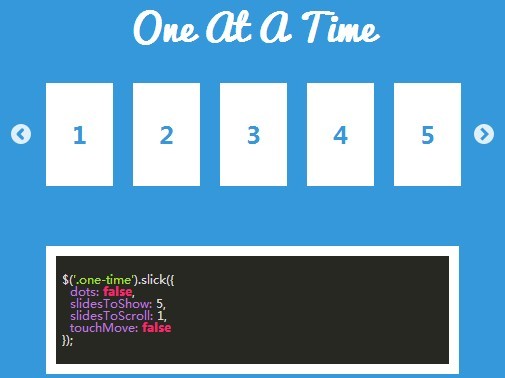
Slick is a jQuery carousel and slider plugin for responsive, touch-enabled content sliders.
You can use breakpoints to change how many slides appear at each screen size, then control navigation, autoplay, lazy loading, and synchronized sliders through its options and API.
Features:
- Responsive breakpoint settings with an optional mobile-first mode.
- Touch swiping, mouse dragging, and keyboard navigation.
- Single-slide, multi-item, center, fade, vertical, and variable-width layouts.
- Autoplay with hover, focus, and dot-hover pause controls.
- On-demand and progressive image lazy loading.
- Synced main and thumbnail sliders through
asNavFor. - Programmatic navigation, filtering, dynamic slides, and runtime option changes.
- Configuration through JavaScript or the
data-slickattribute.
Use Cases:
- Product galleries with a large image slider and synchronized thumbnail navigation.
- Logo, card, or product carousels that change the number of visible items at responsive breakpoints.
- Testimonials, announcements, or featured content that rotate on a timer with dots or arrows.
- Vertical, center-mode, fade, or variable-width sliders for custom page layouts.
How to use it:
jQuery dependency and build choice
Slick requires jQuery. jQuery 4 projects can use the current 2.x GitHub/CDN build. The slick-carousel npm package currently installs 1.8.1, not the 2.x build.
Load Slick with jQuery 4
<link rel="stylesheet" href="https://cdn.jsdelivr.net/gh/kenwheeler/[email protected]/slick/slick.css">
<link rel="stylesheet" href="https://cdn.jsdelivr.net/gh/kenwheeler/[email protected]/slick/slick-theme.css">

<script src="https://code.jquery.com/jquery-4.0.0.min.js"></script>
<script src="https://cdn.jsdelivr.net/gh/kenwheeler/[email protected]/slick/slick.min.js"></script>
Install from npm
The npm registry currently serves Slick 1.8.1. Installing the package returns that legacy build. jQuery 4 projects need the 2.x GitHub/CDN files shown above.
npm install slick-carousel
Basic slider markup
Place each slide inside one carousel container. Slides can contain images, text, cards, or other HTML.
<div class="product-carousel">
  <div><img src="product-1.jpg" alt="Product view 1"></div>
  <div><img src="product-2.jpg" alt="Product view 2"></div>
  <div><img src="product-3.jpg" alt="Product view 3"></div>
</div>
Initialize Slick
Call .slick() on the carousel container after jQuery and Slick have loaded.
$(function() {
  $('.product-carousel').slick({
    dots: true,
    arrows: true
  });
});
Responsive multi-item carousel
The responsive option changes Slick settings at defined breakpoints. The default desktop-first behavior applies each breakpoint when the viewport becomes narrower than that value.
$('.product-carousel').slick({
  slidesToShow: 4,
  slidesToScroll: 1,
  dots: true,
  responsive: [
    {
      breakpoint: 1024,
      settings: {
        slidesToShow: 3
      }
    },
    {
      breakpoint: 768,
      settings: {
        slidesToShow: 2
      }
    },
    {
      breakpoint: 480,
      settings: {
        slidesToShow: 1,
        arrows: false
      }
    }
  ]
});
Autoplay slider
Set autoplay to true and control the interval through autoplaySpeed. Hover and keyboard focus pause autoplay by default.
$('.news-slider').slick({
  autoplay: true,
  autoplaySpeed: 4000,
  pauseOnHover: true,
  pauseOnFocus: true,
  dots: true
});
Synced main slider and thumbnails
The asNavFor option links two Slick instances. focusOnSelect lets a thumbnail move both sliders to the selected item.
$('.gallery-main').slick({
  slidesToShow: 1,
  arrows: false,
  asNavFor: '.gallery-thumbs'
});

$('.gallery-thumbs').slick({
  slidesToShow: 4,
  asNavFor: '.gallery-main',
  focusOnSelect: true
});
Configure Slick with data attributes
The data-slick attribute stores instance settings in the markup. Call .slick() once to initialize the element.
<div class="promo-slider" data-slick='{"slidesToShow":3,"slidesToScroll":1,"dots":true}'>
  <div>Promotion 1</div>
  <div>Promotion 2</div>
  <div>Promotion 3</div>
  <div>Promotion 4</div>
</div>
$('.promo-slider').slick();
Slick Options:
Navigation and Paging Options
| Option | Description |
|---|---|
arrows |
Shows previous and next buttons. Type: Boolean. Default: true. |
prevArrow |
Sets the previous button markup or selector. Type: String, DOM node, or jQuery object. Default: Slick previous button. |
nextArrow |
Sets the next button markup or selector. Type: String, DOM node, or jQuery object. Default: Slick next button. |
appendArrows |
Sets the element that receives the arrow buttons. Type: Selector, HTML string, element, array, or jQuery object. Default: Slider element. |
dots |
Shows slide indicator dots. Type: Boolean. Default: false. |
dotsClass |
Sets the class name for the dots container. Type: String. Default: slick-dots. |
appendDots |
Sets the element that receives the dots container. Type: Selector, HTML string, element, array, or jQuery object. Default: Slider element. |
customPaging |
Returns custom markup for each paging button. Type: Function. Default: Numbered button. |
Slide and Layout Options
| Option | Description |
|---|---|
adaptiveHeight |
Changes slider height to the current slide. Type: Boolean. Default: false. |
centerMode |
Centers the active slide and shows partial neighboring slides. Type: Boolean. Default: false. |
centerPadding |
Sets side padding in center mode. Type: String. Default: 50px. |
fade |
Uses a fade transition. Type: Boolean. Default: false. |
infinite |
Loops slides continuously. Type: Boolean. Default: true. |
initialSlide |
Sets the zero-based starting slide. Type: Integer. Default: 0. |
slide |
Sets a child selector for slide elements. Type: String. Default: Empty string. |
slidesToShow |
Sets the number of visible slides. Type: Integer. Default: 1. |
slidesToScroll |
Sets the number of slides moved per navigation action. Type: Integer. Default: 1. |
variableWidth |
Uses each slide's own width. Type: Boolean. Default: false. |
Responsive, Grid, and Direction Options
| Option | Description |
|---|---|
mobileFirst |
Switches breakpoint evaluation to mobile-first behavior. Type: Boolean. Default: false. |
respondTo |
Uses window, slider, or min as the responsive width source. Type: String. Default: window. |
responsive |
Defines breakpoint and settings objects. A breakpoint can use "unslick" to destroy the slider at that width. Type: Array. Default: null. |
rows |
Sets the number of grid rows. Values above 1 activate grid mode. Type: Integer. Default: 1. |
slidesPerRow |
Sets the number of slides in each grid row. Type: Integer. Default: 1. |
rtl |
Switches the slider to right-to-left direction. Type: Boolean. Default: false. |
vertical |
Uses vertical slide movement. Type: Boolean. Default: false. |
verticalSwiping |
Uses vertical swipe direction. Type: Boolean. Default: false. |
Interaction and Accessibility Options
| Option | Description |
|---|---|
accessibility |
Activates tabbing and arrow-key navigation behavior. Type: Boolean. Default: true. |
draggable |
Activates mouse dragging on desktop. Type: Boolean. Default: true. |
focusOnSelect |
Moves the slider when a slide receives a selection click. Type: Boolean. Default: false. |
focusOnChange |
Moves browser focus to the active slide after a slide change. Type: Boolean. Default: false. |
swipe |
Activates touch swiping. Type: Boolean. Default: true. |
swipeToSlide |
Lets swipe distance select the destination slide independently of slidesToScroll. Type: Boolean. Default: false. |
touchMove |
Lets touch gestures move slides. Type: Boolean. Default: true. |
touchThreshold |
Sets the swipe distance threshold as a fraction of slider width or height. Type: Integer. Default: 5. |
waitForAnimate |
Ignores navigation requests while a slide animation is active. Type: Boolean. Default: true. |
Autoplay and Lazy Loading Options
| Option | Description |
|---|---|
autoplay |
Starts automatic slide rotation. Type: Boolean. Default: false. |
autoplaySpeed |
Sets the delay between automatic slide changes in milliseconds. Type: Integer. Default: 3000. |
pauseOnHover |
Pauses autoplay while the pointer is over the slider. Type: Boolean. Default: true. |
pauseOnFocus |
Pauses autoplay while an element inside the slider has focus. Type: Boolean. Default: true. |
pauseOnDotsHover |
Pauses autoplay while the pointer is over navigation dots. Type: Boolean. Default: false. |
lazyLoad |
Uses ondemand or progressive image loading. Type: String. Default: ondemand. |
Animation and Slider Integration Options
| Option | Description |
|---|---|
asNavFor |
Links another Slick instance for synchronized navigation. Type: Selector string. Default: null. |
cssEase |
Sets the CSS transition timing function. Type: String. Default: ease. |
easing |
Sets the jQuery animate() fallback easing. Type: String. Default: linear. |
edgeFriction |
Sets resistance at the edge of a non-infinite slider. Type: Number. Default: 0.35. |
speed |
Sets transition duration in milliseconds. Type: Integer. Default: 500. |
useCSS |
Activates CSS transitions when supported. Type: Boolean. Default: true. |
useTransform |
Activates CSS transforms when supported. Type: Boolean. Default: true. |
zIndex |
Sets slide z-index values for fade mode and older browser behavior. Type: Number. Default: 1000. |
Slick API Methods:
Navigation and Playback Methods
| Method | Description |
|---|---|
slickNext |
Moves to the next slide. Usage: $('.slider').slick('slickNext'). |
slickPrev |
Moves to the previous slide. Usage: $('.slider').slick('slickPrev'). |
slickGoTo |
Moves to a zero-based slide index. An optional second Boolean skips animation. Usage: $('.slider').slick('slickGoTo', 3). |
slickCurrentSlide |
Returns the current zero-based slide index. Usage: $('.slider').slick('slickCurrentSlide'). |
slickPause |
Pauses autoplay. Usage: $('.slider').slick('slickPause'). |
slickPlay |
Starts autoplay and sets the autoplay option to true. Usage: $('.slider').slick('slickPlay'). |
Dynamic Slide and Filter Methods
| Method | Description |
|---|---|
slickAdd |
Inserts a slide from an HTML string or DOM object. Optional index and addBefore arguments control placement. |
slickRemove |
Removes a slide by index. The optional Boolean controls removal before the supplied index. |
slickFilter |
Filters slides with a jQuery-compatible selector or function. |
slickUnfilter |
Restores slides after a filter has been applied. |
Configuration and Instance Methods
| Method | Description |
|---|---|
slickGetOption |
Returns the current value of an option. Usage: $('.slider').slick('slickGetOption', 'slidesToShow'). |
slickSetOption |
Changes one option, multiple options, or responsive settings. Pass true as the refresh argument when the UI must be recalculated. |
getSlick |
Returns the Slick instance object. Usage: $('.slider').slick('getSlick'). |
setPosition |
Recalculates slide positioning. Usage: $('.slider').slick('setPosition'). |
unslick |
Destroys the Slick instance and restores the element. Usage: $('.slider').slick('unslick'). |
Change options after initialization
slickSetOption can update one setting or several settings on an existing slider. Pass the refresh flag when the new value affects layout.
$('.product-carousel').slick('slickSetOption', 'slidesToShow', 3, true);

$('.product-carousel').slick('slickSetOption', {
  arrows: false,
  dots: true
}, true);
Slick Events:
Slide and Lifecycle Events
| Event | Fires When |
|---|---|
init |
The slider initializes for the first time. |
reInit |
The slider initializes again after an internal refresh. |
beforeChange |
A slide change starts. Arguments include the current and next slide indexes. |
afterChange |
A slide change finishes. Arguments include the Slick instance and current slide index. |
setPosition |
Slick recalculates slide positioning. |
breakpoint |
A responsive breakpoint is reached. |
destroy |
The slider is destroyed. |
Interaction and Lazy Loading Events
| Event | Fires When |
|---|---|
swipe |
A swipe or drag finishes. |
edge |
A swipe reaches an edge in non-infinite mode. |
lazyLoaded |
A lazy-loaded image finishes loading. |
lazyLoadError |
A lazy-loaded image fails to load. |
Listen for slide changes
Bind events before initialization when you also need the first init event.
$('.product-carousel')
  .on('init', function(event, slick) {
    console.log('Slides:', slick.slideCount);
  })
  .on('beforeChange', function(event, slick, currentSlide, nextSlide) {
    console.log('Moving to:', nextSlide);
  })
  .on('afterChange', function(event, slick, currentSlide) {
    console.log('Current slide:', currentSlide);
  })
  .slick({
    dots: true
  });
Alternatives and Related Resources:
- 10 Best Carousel Plugins In jQuery/JavaScript/CSS
- Glide.js: Responsive JavaScript Slider & Carousel with CSS3 Transitions
- Swiper Slider: Responsive Mobile Touch Slider for JavaScript & jQuery
- Copy-Paste React Carousel with Tailwind and shadcn/ui - Carouselcn
- Google Style Horizontal Carousel jQuery Plugin - g-scrolling-carousel
FAQs:
Q: Does Slick require jQuery?
A: Yes. Slick is a jQuery plugin and must load after jQuery.
Q: Does Slick work with jQuery 4?
A: Yes. The current 2.x build includes jQuery 4 compatibility. Load jQuery before Slick.
Q: Why does npm install slick-carousel install version 1.8.1?
A: The npm package currently installs version 1.8.1. Use the GitHub/CDN 2.x files for jQuery 4 projects.
Q: How do I create a responsive Slick carousel with a different number of visible slides?
A: Set the desktop value through slidesToShow, then define smaller viewport settings inside the responsive array.
Q: How do I destroy a Slick slider?
A: Call $('.slider').slick('unslick'). You can initialize the element again later with a new .slick() call.
Changelog:
v2.0.1 (2026-07-30)
- Fixed right-to-left layouts when
rtl: trueis used with variable-width slides.
v2.0.0 (2026-07-24)
- Added compatibility with jQuery 4.
- Updated focus handling, center-mode behavior, cloned slide IDs, dot labels, transforms, fonts, and drag cursor behavior.
v1.9.0 (2018-04-19)
- update.
v1.5.9 (2016-02-05)
- update.
v1.4.0 (2015-01-26)
- update.
v1.3.3 (2014-04-09)
- Fixing menu for firefox
v1.3.2 (2014-04-03)
- Changing prev/next anchors to button tags
- updating styles
- updating placeholder code
v1.2.8 (2014-03-31)
- Adding Fade
v1.2.7 (2014-03-30)
- Add/Remove items patch
v1.2.4 (2014-03-29)
- Removing sprites, adding icon font
v1.2.1 (2014-03-28)
- update.
This awesome jQuery plugin is developed by kenwheeler. For more Advanced Usages, please check the demo page or visit the official website.