Slim Password Strength Meter for jQuery & Vanilla JS - Passcore
| File Size: | 419 KB |
|---|---|
| Views Total: | 4959 |
| Last Update: | |
| Publish Date: | |
| Official Website: | Go to website |
| License: | MIT |
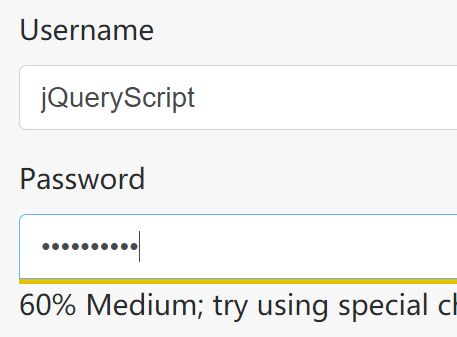
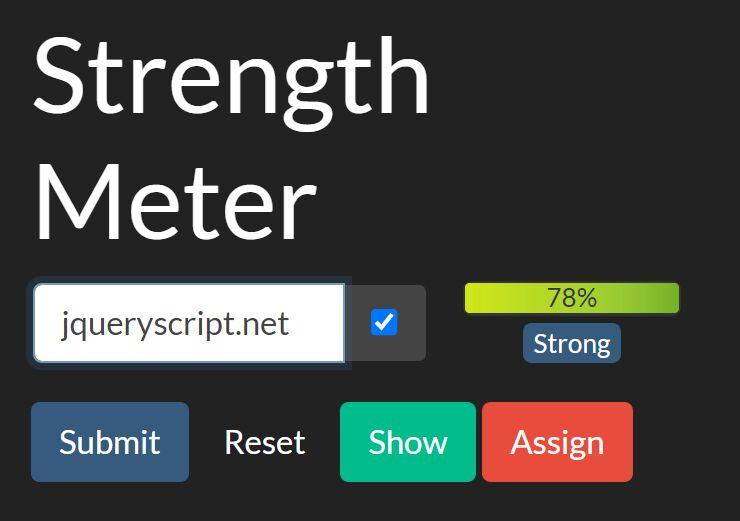
Passcore is a password strength meter for jQuery and Vanilla JavaScript that evaluates passwords as they are typed.
It attaches a strength bar and feedback messages to an existing password field, with a shared scoring engine for both implementations.
Features:
- Live strength percentages and five nonempty strength levels.
- Checks for common passwords, personal details, and repeated or predictable patterns.
- Configurable password length and character requirements.
- Accessible meter values and screen-reader feedback.
- Custom messages, translations, and strength thresholds.
- CSS custom properties for the progress bar and strength colors.
- jQuery plugin, Vanilla JavaScript function, and HTML custom element.
- Events and callbacks for changes to scores and feedback messages.
Installation:
Install the jQuery package for an existing jQuery form, or the Vanilla JavaScript package for a dependency-free browser integration. Both packages use the @passcore/core scoring engine.
# jQuery 3 or 4
npm install @passcore/jquery jquery

# Vanilla JavaScript
npm install @passcore/vanilla

# Headless scoring only
npm install @passcore/core
How to Use Passcore with jQuery:
Basic Browser Setup
The standalone jQuery build includes the core evaluator. Load its stylesheet, jQuery, and the Passcore plugin in the document. Wrap the input in a div for the default closestSelector setting.
<link rel="stylesheet" href="https://cdn.jsdelivr.net/npm/@passcore/jquery@1/dist/styles.css">

<div class="form-group">
  <label for="username">Username</label>
  <input type="text" id="username" autocomplete="username">
  <label for="password">New password</label>
  <input type="password" id="password" autocomplete="new-password">
</div>

<script src="https://cdn.jsdelivr.net/npm/jquery@3/dist/jquery.min.js"></script>
<script src="https://cdn.jsdelivr.net/npm/@passcore/jquery@1/dist/password.min.js"></script>
<script>
  jQuery(function ($) {
    $('#password').password({
      userInputs: ['#username'],
      showPercent: true,
      animate: false,
      rules: { minLength: 10 }
    });
  });
</script>
ES Module Setup
Use the HTML fields from the browser example above. The package registers $.fn.password on the imported jQuery instance.
import $ from 'jquery';
import '@passcore/jquery';
import '@passcore/jquery/styles.css';

$(function () {
  $('#password').password({
    userInputs: ['#username'],
    rules: { minLength: 10, numbers: 1 }
  });
});
Register the Plugin on Another jQuery Instance
When a page uses a different jQuery instance from the imported module, register the plugin on that instance explicitly.
import { install } from '@passcore/jquery';

install(window.jQuery);
window.jQuery('#password').password();
React to Password Scores in jQuery
The password.score event receives (event, percent, result) on updates. The result.valid flag reports whether all enabled password rules pass.
<div class="form-group">
  <label for="registration-password">New password</label>
  <input type="password" id="registration-password" autocomplete="new-password">
</div>
<button type="button" id="next-button" disabled>Continue</button>
$('#registration-password')
  .on('password.score', function (event, percent, result) {
    $('#next-button').prop('disabled', !result.valid);
  })
  .on('password.text', function (event, text, result) {
    console.log(text, result.level);
  })
  .password({
    animate: false,
    rules: { minLength: 10, numbers: 1 }
  });
How to Use Passcore with Vanilla JavaScript:
Basic Browser Setup
The standalone Vanilla JavaScript build exposes passcore.createPasswordMeter() and does not require jQuery. It inserts the meter immediately after the input unless you set a custom container.
<link rel="stylesheet" href="https://cdn.jsdelivr.net/npm/@passcore/vanilla@1/dist/styles.css">

<label for="plain-username">Username</label>
<input type="text" id="plain-username" autocomplete="username">
<label for="plain-password">New password</label>
<input type="password" id="plain-password" autocomplete="new-password">

<script src="https://cdn.jsdelivr.net/npm/@passcore/vanilla@1/dist/passcore.min.js"></script>
<script>
  const meter = passcore.createPasswordMeter('#plain-password', {
    userInputs: ['#plain-username'],
    showPercent: true,
    rules: { minLength: 10 }
  });
</script>
ES Module Setup
For a bundler-based project, use the plain-password and plain-username fields from the HTML example above.
import { createPasswordMeter } from '@passcore/vanilla';
import '@passcore/vanilla/styles.css';

const meter = createPasswordMeter('#plain-password', {
  userInputs: ['#plain-username'],
  hideUntilFocus: true,
  rules: { minLength: 10, numbers: 1 }
});
HTML Custom Element
The <passcore-meter> custom element displays its meter at the element's location. Its required for attribute matches the password input's ID.
<link rel="stylesheet" href="https://cdn.jsdelivr.net/npm/@passcore/vanilla@1/dist/styles.css">

<label for="element-password">New password</label>
<input type="password" id="element-password" autocomplete="new-password">
<passcore-meter for="element-password" min-length="10" show-percent></passcore-meter>

<script src="https://cdn.jsdelivr.net/npm/@passcore/vanilla@1/dist/passcore-element.min.js"></script>
Configuration Options:
Shared Meter and Scoring Options
Both DOM integrations accept these options. The rules and levels objects merge with their defaults.
| Option | Default and Behavior |
|---|---|
userInputs |
[]. Form values that the password must not contain. Selectors are evaluated against all matching elements; DOM elements and functions are accepted. The jQuery adapter also accepts jQuery objects. |
showPercent |
false. Display the numeric percentage. |
showText |
true. Display feedback beside the meter. |
label |
'Password strength'. Accessible meter label, read at creation. |
translations |
{}. Override translated strings in i18next JSON format. |
locale |
'en'. Locale for plural forms. |
translate |
undefined. Custom (key, params) => string translation function. |
targetBits |
100. Estimated bits corresponding to 100%. |
estimator |
undefined. Custom (password, userInputs) => bits estimator. |
commonPasswords |
undefined in DOM adapters. Supply a replacement common-password collection. |
rules |
Rule object. Defaults and rule names appear below. |
levels |
Strength threshold object. Defaults appear below. |
jQuery Options
| Option | Default and Behavior |
|---|---|
animate |
true. Hide the bar until focus and animate it on focus or blur. |
animateSpeed |
'fast'. jQuery animation speed. |
closestSelector |
'div'. Ancestor container that receives the meter. |
Vanilla JavaScript Options
| Option | Default and Behavior |
|---|---|
container |
undefined. Append to an element or selector. By default, insert immediately after the input. |
hideUntilFocus |
false. Show the meter on focus; hide it on blur when the field is empty. |
listen |
true. Listen to input, focus, and blur. Set to false and call refresh() manually. |
Password Rules
| Rule | Default and Behavior |
|---|---|
minLength |
8. Minimum password length; 0 disables the rule. |
maxLength |
0. Maximum length; disabled by default. |
lowercase |
0. Minimum lowercase character count. |
uppercase |
0. Minimum uppercase character count. |
numbers |
0. Minimum numeric character count. |
symbols |
0. Minimum ASCII symbol or space character count. |
notUserInputs |
true. Reject passwords containing values passed through userInputs. |
notCommon |
true. Reject common passwords and simple numeric or symbolic variations. |
Strength Levels
Each level begins at its percentage threshold. The empty level applies to an empty password.
| Level | Default Minimum |
|---|---|
very-weak |
0 |
weak |
20 |
fair |
40 |
good |
60 |
strong |
80 |
For example, the jQuery plugin accepts a partial rules object and a custom strength threshold:
$('#password').password({
  rules: { minLength: 12, numbers: 1, symbols: 1 },
  levels: { strong: 90 },
  animate: false
});
API Methods and Commands:
jQuery Plugin Commands
Calling .password(options) again replaces the existing meter. All three commands return the selected jQuery collection; refresh and destroy do nothing for an uninitialized field.
| Command | Action |
|---|---|
.password(options) |
Create or replace a meter for each selected input. |
.password('refresh') |
Reevaluate the password and update the feedback. |
.password('destroy') |
Remove meter markup, listeners, and associated accessibility attributes. |
Vanilla JavaScript Instance
createPasswordMeter(input, options) returns a meter instance.
| Member | Behavior |
|---|---|
meter.result |
Last evaluation result. |
meter.refresh() |
Reevaluate and render the meter; returns the result. |
meter.focus() |
Apply the meter's focus behavior. |
meter.blur() |
Apply the meter's blur behavior. |
meter.destroy() |
Remove markup and listeners; restore aria-describedby. |
Custom Element Attributes
| Attribute | Behavior |
|---|---|
for |
Required ID of the password input. |
min-length |
rules.minLength. |
max-length |
rules.maxLength. |
target-bits |
targetBits. |
show-percent |
Display the percentage. |
hide-text |
Hide the feedback message. |
hide-until-focus |
Hide the meter until input focus. |
locale |
Pluralization locale. |
label |
Accessible meter label. |
user-inputs |
One CSS selector list, for example #username, #email. |
Configure other options through the custom element's options property. Property values override attributes.
document.querySelector('passcore-meter').options = {
  rules: { numbers: 1 },
  translations: { empty: 'Enter a password' }
};
Events and Callbacks:
jQuery Events
| Event | Arguments and Behavior |
|---|---|
password.score |
(event, percent, result). Fires on each input update and refresh, including when the evaluated result does not change. |
password.text |
(event, text, result). Fires when the message key or parameters change. |
Vanilla JavaScript Callbacks
These callback options run after creation, not during the initial render.
| Callback | When It Runs |
|---|---|
onScore(percent, result) |
undefined by default. Runs when the evaluated result changes. |
onText(text, result) |
undefined by default. Runs when the message key or parameters change, even when showText is false. |
Vanilla JavaScript DOM Events
Both events bubble from the password input. Their detail objects contain the full evaluation result.
| Event | Detail |
|---|---|
passcore:score |
{ percent, result }. Fires when the result changes. |
passcore:text |
{ text, result }. Fires when the message changes. |
const input = document.querySelector('#plain-password');

input.addEventListener('passcore:score', function (event) {
  console.log(event.detail.percent, event.detail.result.valid);
});

input.addEventListener('passcore:text', function (event) {
  console.log(event.detail.text);
});
Use the Core Password Evaluator:
@passcore/core calculates password strength and checks rules independently of DOM access or HTML rendering. It can run in browser code or server-side JavaScript.
import { createMeter } from '@passcore/core';

const checker = createMeter({
  rules: { minLength: 10, numbers: 1 }
});

const result = checker.evaluate(
  'correct horse battery staple 2',
  ['johndoe', '[email protected]']
);

console.log(result.percent, result.level, result.valid);
Core API
| API | Behavior |
|---|---|
createMeter(options) |
Resolve the options once and return an evaluator for repeated use. |
meter.evaluate(password, userInputs) |
Return a new evaluation result; userInputs contains literal values, not selectors. |
meter.options |
Frozen resolved configuration. |
evaluate(password, options) |
Perform a single evaluation. Pass userInputs inside options. |
createTranslator(translations, locale) |
Create a translator from an object or an ordered array of translation layers. |
translationParams(message) |
Prepare translation parameters, including pluralization count. |
defaultOptions |
Frozen default core options. |
commonPasswords |
Bundled common-password collection; it can be extended in a custom configuration. |
Evaluation Result
| Field | Meaning |
|---|---|
bits |
Estimated password strength. |
percent |
Integer from 0 to 100, relative to targetBits. |
level |
empty, very-weak, weak, fair, good, or strong. |
valid |
true when all enabled password rules pass. |
rules |
Array of { id, passed, params } entries for enabled rules. |
message |
{ key, params } describing the first failing rule or the strength level. |
Customize Messages and Styling:
Custom Feedback Messages
Messages use i18next-style JSON keys and {{count}} placeholders. English, Spanish, and Catalan translations are available. For the jQuery plugin:
$('#password').password({
  translations: {
    empty: 'Enter a password',
    rule: {
      minLength_one: 'Enter at least {{count}} character',
      minLength_other: 'Enter at least {{count}} characters'
    }
  },
  rules: { minLength: 10 }
});
CSS Custom Properties
The stylesheet accepts these public color and sizing properties. These values are examples for custom themes.
| Property | Example Value |
|---|---|
--pass-height |
6px |
--pass-track |
#eee |
--pass-color-very-weak |
#b91c1c |
--pass-color-weak |
#c2410c |
--pass-color-fair |
#a16207 |
--pass-color-good |
#4d7c0f |
--pass-color-strong |
#15803d |
Rendered Markup and CSS Classes
The meter uses role="meter" and ARIA values from 0 to 100. Its feedback text has aria-live="polite", and the password input's aria-describedby points to that text. The default stylesheet also handles forced-colors mode.
| Class | Purpose |
|---|---|
pass-wrapper |
Outer meter wrapper. |
pass-meter |
ARIA meter track. |
pass-bar |
Strength bar element. |
pass-percent |
Visible numeric percentage. |
pass-text |
Feedback message and live region. |
pass-level-* |
Wrapper class for the strength level, for example pass-level-weak. |
pass-invalid |
Wrapper class when an enabled rule fails. |
pass-hidden |
Hidden wrapper state for Vanilla JavaScript's hideUntilFocus. |
pass-strength-visible |
Class on the meter's containing element while it is shown. |
Migrating from the Original jQuery Plugin:
The password-strength-meter 2.x plugin uses different option names and scoring behavior. Its 3.x npm compatibility release retains the old API. The replacement jQuery package is @passcore/jquery.
| Old Option | Passcore 1.x Replacement |
|---|---|
enterPass |
translations.empty |
shortPass |
translations.rule.minLength_one / minLength_other |
containsField |
translations.rule.notUserInputs |
steps |
levels for thresholds; translations.level for messages |
minimumLength |
rules.minLength; the default changed from 4 to 8 |
field |
userInputs: ['#username'] |
fieldPartialMatch |
Removed; user input text is matched anywhere in the password. |
useColorBarImage, customColorBarRGB |
Removed; style the meter with CSS custom properties. |
messages (older releases) |
translations or translate |
Alternatives and Related Resources:
- 10 Best Password Strength Checkers In JavaScript (2026 Update)
- Check The Strength Of A Password - password-strength.js
- jQuery Plugin For Password Strength Checker and Indicator - Password-Strength
- Vanilla JS Password Strength Checker for Better Form Security
Changelog:
2026-10-09
- The plugin is rewritten and renamed to passcore
This awesome jQuery plugin is developed by elboletaire. For more Advanced Usages, please check the demo page or visit the official website.